Kody · 2025 · B2B2C · Open Banking
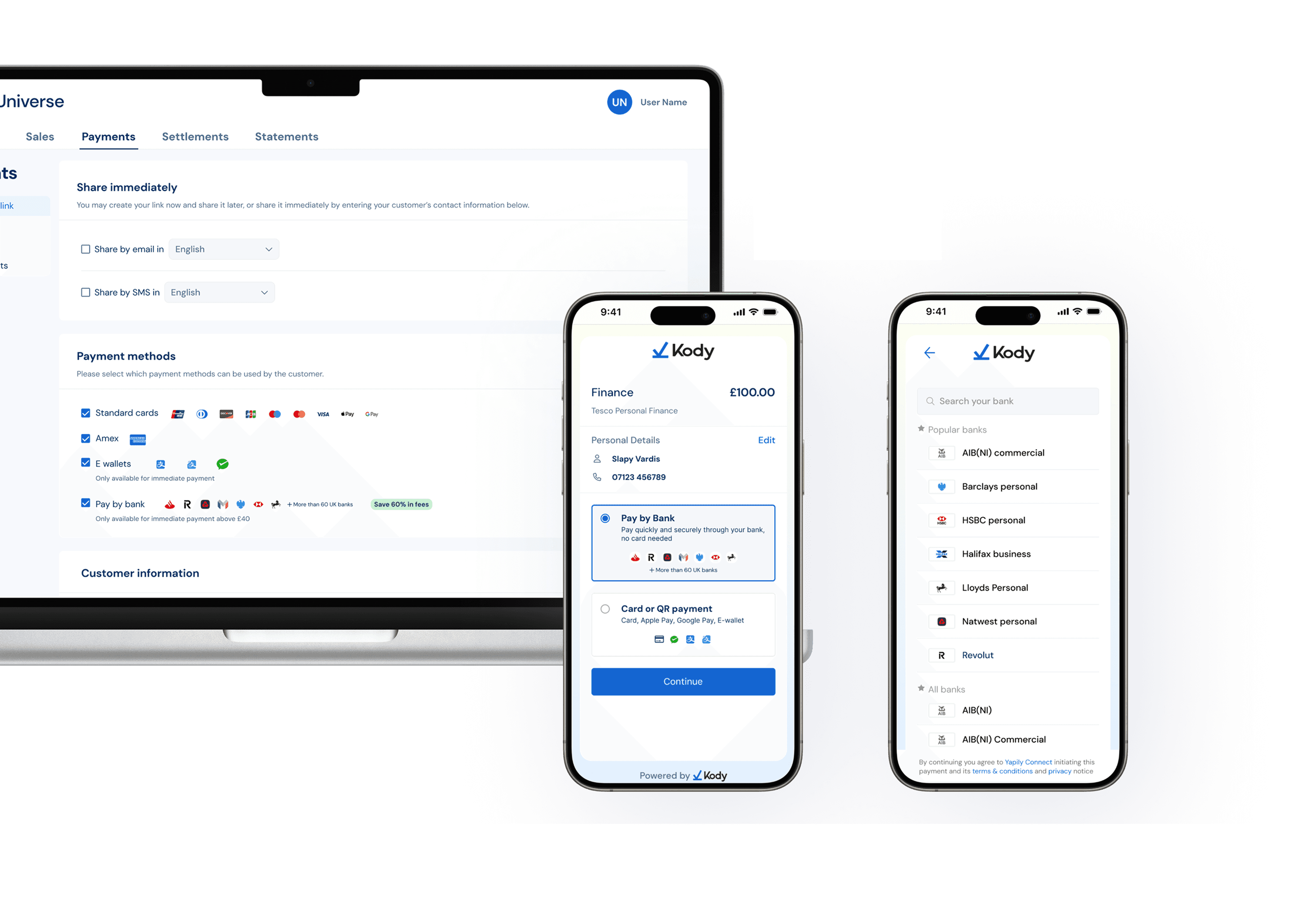
Choosing the Right Channel to Grow Pay by Bank

Detailed process of how I contributed to finding the strategy and pivoting to the correct channel for Pay by Bank

At Kody, a UK payments startup, leadership asked the team to add 64 more banks to our in-person terminal in order to lift Pay by Bank adoption. After one week of user research, I made the case for a different direction: Pay by Bank is a context-sensitive product, and the terminal wasn't the right context. The team pivoted to integrating Pay by Bank into Pay by Link instead — a channel where the product's strengths actually translate into adoption.

After pivoting, Pay by Bank transaction volume grew 120% in the first month.

Case B cover
Case B

Designing Pay by Bank for Pay by Link

Case Study

Choosing the Right Channel to Grow Pay by Bank

A cold start with a clear target

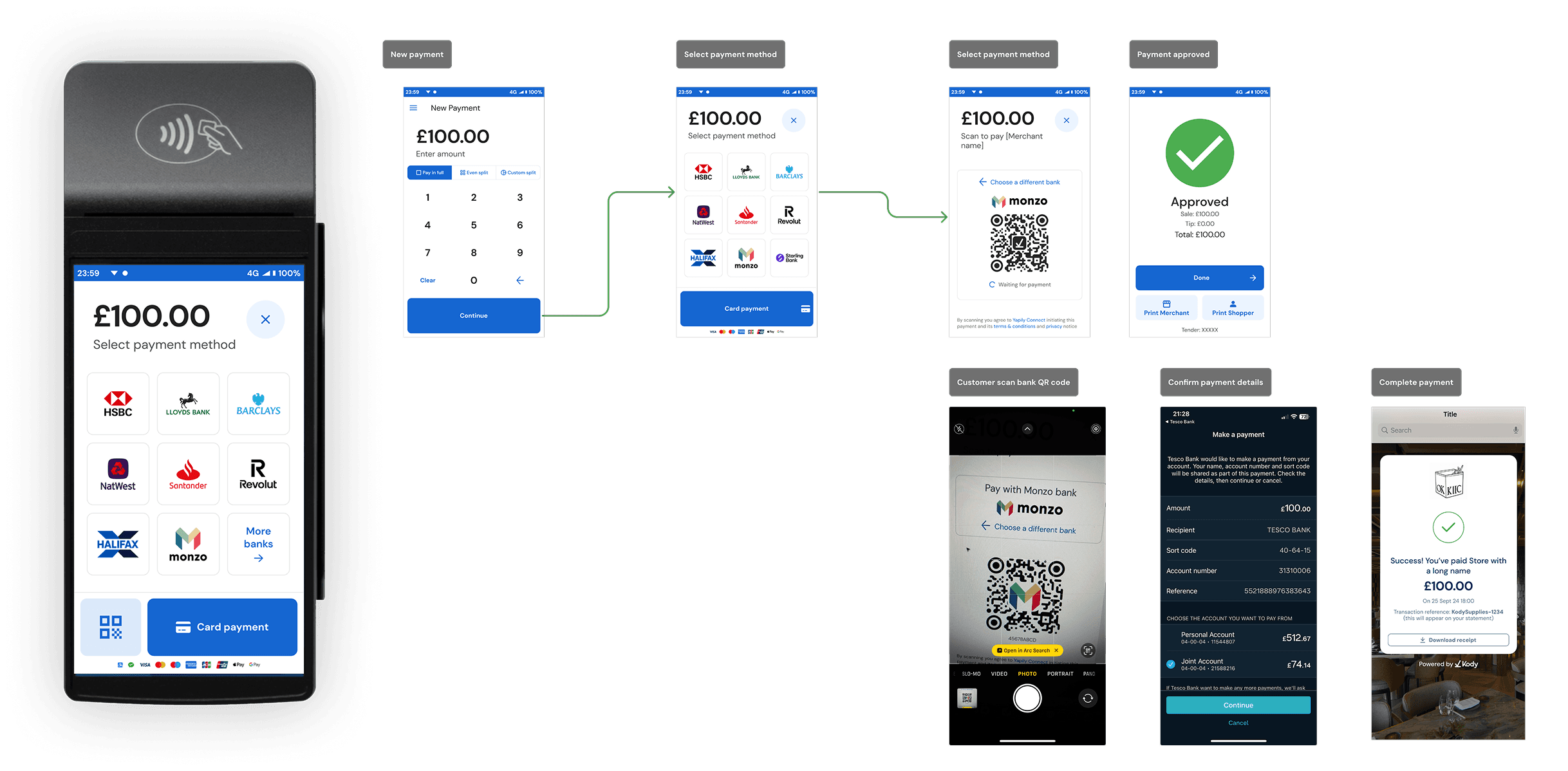
Pay by Bank (PBB) is Kody's Open Banking payment method. It launched on in-person terminals, prompting customers to scan a QR code and pay in their bank app on their mobile device (typically for transactions above £40).

However, after the first version launched in one and a half months, the numbers were flat. Adoption was low, and the data volume was too small to tell us why.

When I joined, the brief was already in place: integrate 64 more banks into our in-person payment terminal, and lift Pay by Bank adoption by 30% this quarter. Five weeks of development.

Business requests
1.

Add 64 more bank options into this payment method.

2.

Achieve a 30% increase in adoption rate in this iteration.

Constraints
1.

Terminal is a core tool that values speed and stability, which are the main requirements in an offline payment scenario.

2.

£40+ transaction threshold (cost/business constraint).

3.

Team resources are limited, requiring swift directional decisions.

4.

No PM in the team for this version development.

Cold start diagram

Learn why adoption stalled

With limited usage data and a high implementation cost, shipping changes without research would have been largely guesswork. Rather than having engineers spend 4 weeks hardcoding bank options — with considerable maintenance to follow — I ran 10+ rapid qualitative interviews with merchants and frontline staff to identify the real adoption blockers before investing in a build.

Merchants / Business Owners× 4
Frontline staff× 6
End payer× 3
Research insights

Three different user groups raised multiple issues about the Pay by Bank method. I organised them into three dimensions:

Merchant
Front line staff
Payer
Awareness
Doesn't know when to recommend it
Doesn't know what it is
Doesn't know why they'd use it
Operation
Not present at checkout, can't observe what's happening
High explanation cost, awkward fallback when it fails
Three context switches: terminal → QR → bank app → back
Risk
Anxious about the refund flow
Fumbling in front of customers when signal drops
Fear of a public failure while others wait
Perceived value
Fee savings exist but are invisible
Absorbs 100% of operational cost, captures 0% of the savings
Absorbs 100% of cognitive cost, captures 0% of the savings

During the interviews, the most frequent challenge from merchants and customers was:

“Why would I ever do this instead of just tapping my card?”

What does PAY BY BANK on terminal mean to users?

At the offline payment context, card payment is the default — fastest, most familiar, most reliable method. PBB never offers users more than card does.

MerchantMerchant
⚠️

Invisible transaction fee saving
Even Pay by Bank can help save around 60% transaction fee, few business owners are aware of this benefit

Front line staffFront line staff

Zero upside — only added work

PayerPayer

Zero upside — only added steps

What's the Product-strategy Problem?

From the qualitative research, it is clear that PBB isn't losing to card on product capability in the offline payment environment — it's losing on context fit. The problem shifts from “how to improve PBB on terminal” to:

Where can PBB deliver net upside to all three users in a transaction — and does that context exist within Kody's current product surface?

Channel Audit

After all the insights, I held a deep-dive with the CTO, Head of PD, Tech Lead, and PM to align on my findings and present my hypothesis on the right channel.

Based on this hypothesis, I drafted a few criteria to define a context for Pay by Bank:

Criteria
Low-urgency payment moments (not queue-based)
Typical AOV above £40 (aligned with the business constraint)
A self-controlled environment (payer is not dependent on a venue's connection or a staff member to explain the flow)

With those criteria, I listed all the payment channels Kody was operating and pulled AOV data for each with help from data analytics, evaluating each against the context requirements from the previous section. Pay by Link emerged as the primary fit for Pay by Bank.

ChannelTime pressure low?AOV ≥ £40 likely?Self-controlled environment?Verdict
Terminal⚠️Current failure mode
Pay by LinkMatch, primary fit
Online checkout⚠️ variesSecondary fit, low Kody coverage
QR payment at table⚠️Time-pressure issue + low AOV

The Pivot Decision

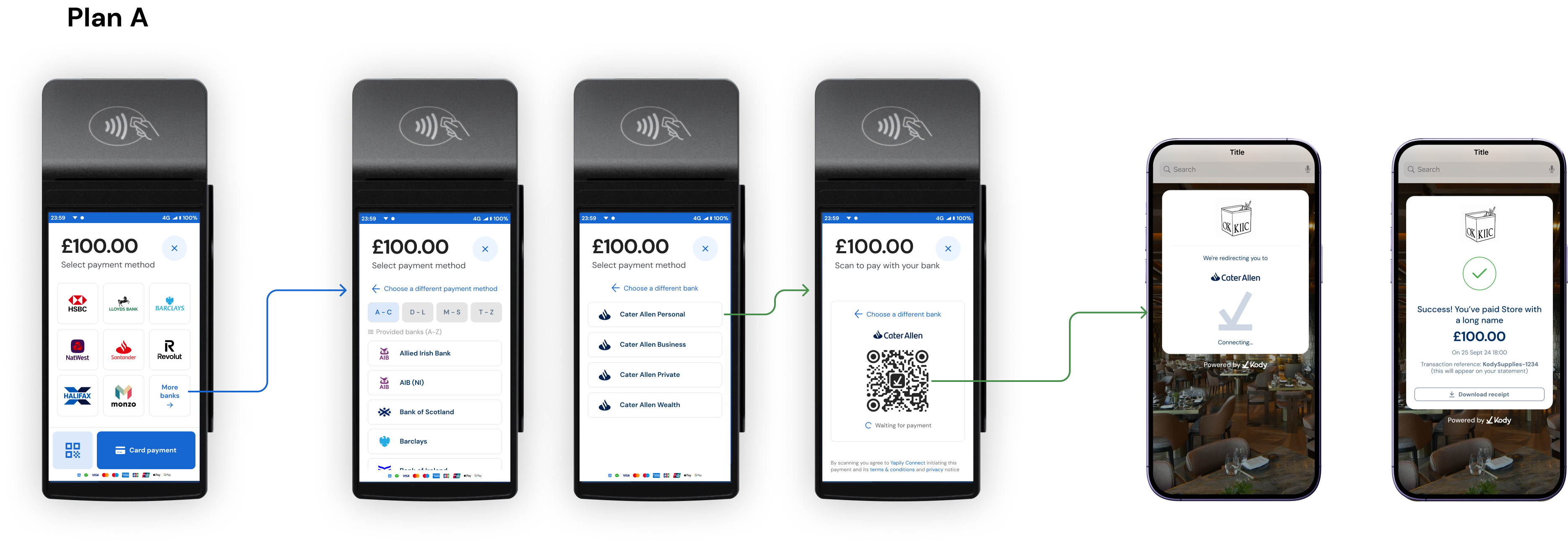
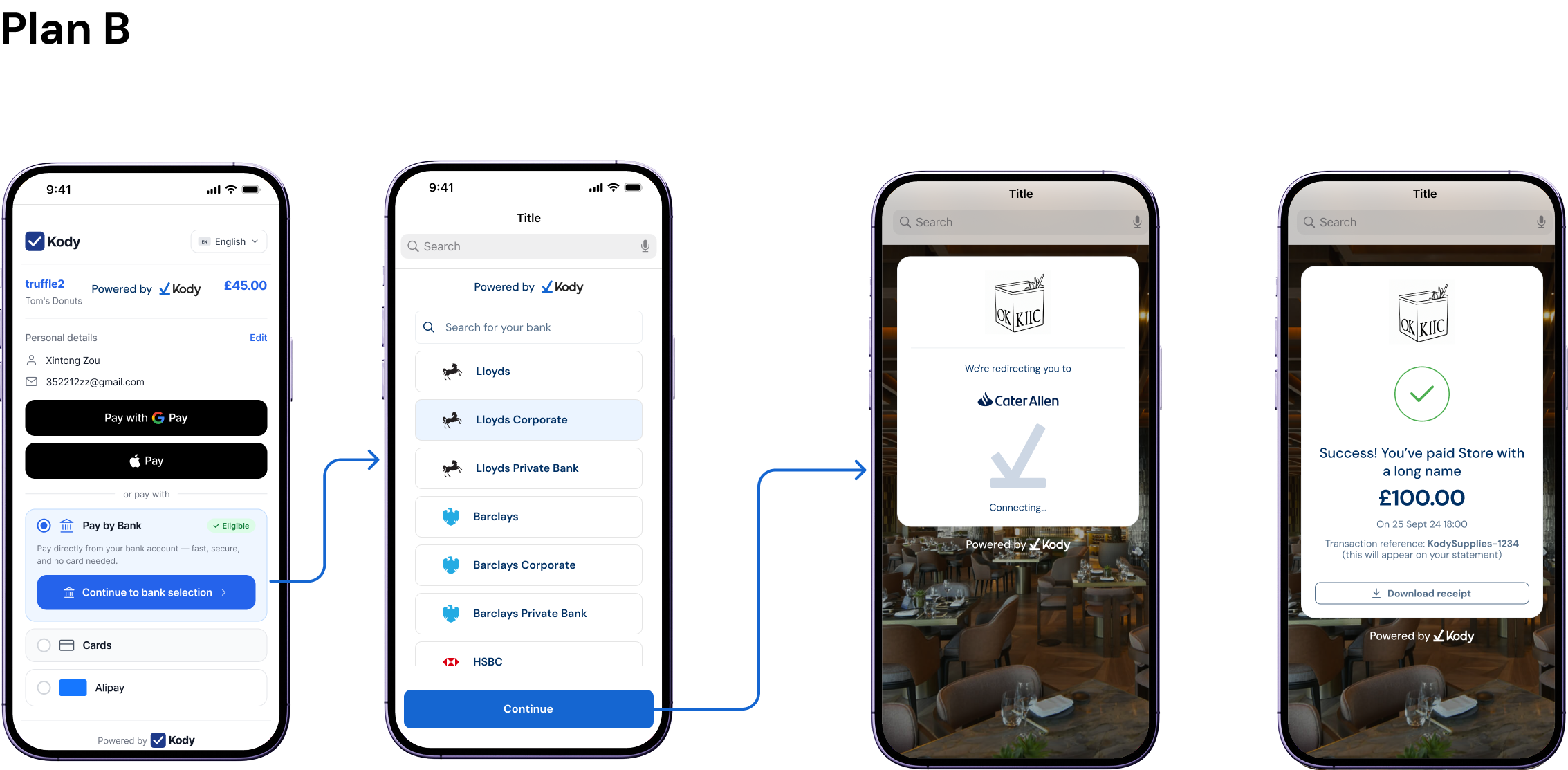
In a discussion with the Tech Lead and Design Lead, alongside the insights from interviews and the channel hypothesis, I presented high-fidelity prototypes — one with extended bank options on terminal, and one with Pay by Bank in the payment link. I quickly built the prototypes with the help of AI (Figma Make) to walk everybody through the pros and cons from tech cost and experience perspectives to persuade my team.

Prototype comparison: terminal expansion vs Pay by Link

Only expand the bank options on terminal

Pros: Fits with the initial business requirement without significant structural changes.

Cons: Significantly slows down staff operation speed and increases the error rate. Engineers would need to hardcode each bank option — extra cost and at least 3 weeks of implementation time.

Pay by Bank in Pay by Link flow example

This image is an example of the PBB flow, not the final design. Please check Designing Pay by Bank for Pay by Link for the final design.

Integrate PBB into the payment link channel while deprioritising PBB on terminal

Pros:Can directly use the API provider on the web environment to save development time. Applying PBB on the user's own device instead of switching between devices better matches the payment context.

Cons: Requires redesigning the Pay by Link checkout flow and coordinating cross-team on terminal deprioritisation messaging.

Results

Roadmap updated

The pivot was successfully reflected on the product roadmap. Instead of having “expand bank options” as the P0 task, the P0 task became “explore integrating PBB into Pay by Link and help business owners understand the benefit of PBB.” The new P1 requirement became deprioritising PBB on terminal for target users — for a better terminal experience and brand reputation.

Effort

Impact

Low effort

High impact

High effort

Low impact

Integrate PBB into PBL

Deprioritise PBB on terminal

Expand bank coverage

Highlight PBB's cost-saving benefits

Terminal: explore new interaction methods (e.g., NFC)

Refund support

Phase One: Focus on key users' needs

Phase Two: Expand to broader merchant base

Effort

Impact

Low effort

High impact

High effort

Low impact

Expand bank coverage on terminal

Terminal: explore new interaction methods (e.g., NFC)

Refund support

P0

P1

Original roadmapNew roadmap

In a separate case study I cover how I designed the actual Pay by Link checkout integration — the UX work that brought this pivot to life.

Case B cover
Case B

Designing Pay by Bank for Pay by Link